
June 13, 2026
What a large-scale deployment looks like
How a global enterprise runs MisterShell in production across five regions, 100+ locations, and 1,000+ network resources — stood up in under a day.
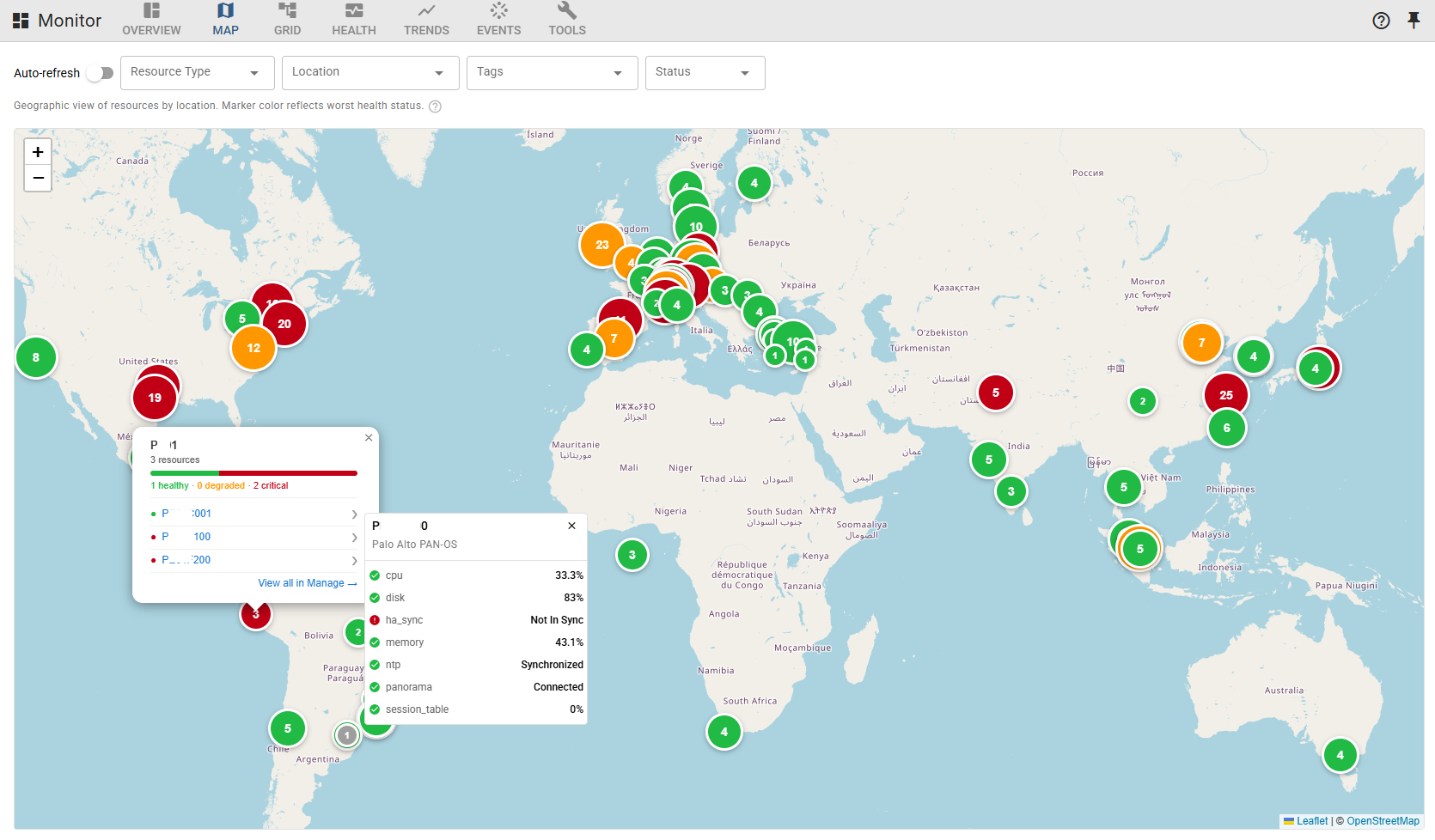
People often ask what MisterShell looks like once it is running at real scale. Here is one production deployment — anonymized, but real — at a global enterprise.
The organization
A company headquartered in the EU, with roughly 20 factories worldwide and around 100 sales and marketing locations including regional headquarters — over 10,000 employees in all.
Their infrastructure is a multi-region mix of cloud and on-prem workloads, with a network of 200+ routers and 700+ switches, alongside firewalls, Linux servers, and specialized appliances: over 1,000 managed resources spread across more than 100 locations.
The deployment
MisterShell is run by the network team, and the footprint is deliberately small:
- The core didn’t even get a dedicated machine. It was added as one more Docker workload on an existing 4 vCPU / 8 GB VM in an EU cloud region that was already running a few containers.
- Five remote workers, one per region, each deployed onto a pre-existing Linux jump host the team already ran — small 2 vCPU / 4 GB VMs — aggregating infrastructure access for its part of the world:
- Europe, Middle East & Africa
- North America
- South America
- Asia Pacific
- China, as its own region
Every worker connects outbound only to the core — no inbound firewall rules into any region, and no resource exposed to the internet.
Configuration and health are refreshed automatically every six hours — four snapshots a day for every resource — with a full year of history retained, so the per-resource timeline is always current.
Live in under a day
The entire deployment — the core and all five regional workers — went live in less than a day. That included:
- Standing up the core — a single Docker container added to an existing VM, with first-run configuration done in the UI.
- Bringing up the five regional workers — one outbound-only container per region on a jump host the team already ran, each paired to the core with a token.
- Importing the existing estate in bulk through the UI’s CSV import.
- Delegating authentication to Microsoft Active Directory, with LDAP groups mapped to MisterShell roles — configured entirely from the UI.
No professional-services engagement, no multi-week rollout: a small team stood the whole thing up themselves.
A day in the life
The network team now operates the global network from a single browser:
- Daily operations across switches, routers, firewalls, Linux servers, and specialized appliances over SSH — every session governed and recorded.
- AI assistance on hand whenever an operator wants it.
- Configuration change tracking across every device.
- Weekly reports, each opening with an AI-generated executive summary.
- Automated troubleshooting: when a health degradation is detected, a playbook fires — an AI agent analyzes the situation, then emails the team.
The quiet part
MisterShell doesn’t take humans out of the loop at this scale — the engineers still operate hands-on. What changes is how boring the routine becomes.
Instead of scrolling through pages of interface counters and interpreting them by hand, an engineer just asks: “What was the last change on this router about?” or “Any packet drops or performance issues here?” — and gets a grounded answer in seconds, drawn from the resource’s own history and live state. The tedious part of network operations quietly disappears.
Room to grow
This estate runs on a single core today, and that has been more than enough for the network team. When a deployment does need the core itself to be redundant, nothing here has to be re-architected: the same image runs active/active — several cores clustering in one region with no single point of failure, and cores across regions for geographic reach — behind a load balancer, a highly-available database and cache the operator runs, and an object store for recordings. High availability is a deployment choice (multi-core comes with the Pro edition), not a different product.
The shape of MisterShell at scale
A core sharing an existing VM. Five workers on existing jump hosts. Over 1,000 devices across more than 100 locations and five regions, refreshed four times a day. Operated by a small team — and stood up in a day.
That is the shape of MisterShell at scale: lightweight to run, fast to deploy, and governed end to end.